z6首页 in the AIR

Overview
Date
May 03, 2022
21:00 - 22:35
Venue

活动行

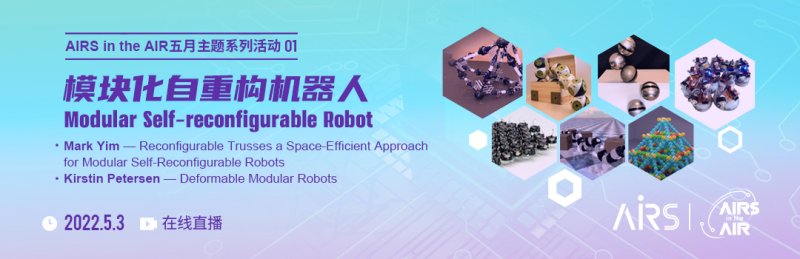
z6首页 in the AIR | Modular Self-reconfigurable Robot (Session 1)

Z6集团|中国官网

Modular self-recon?gurable robots have become a hot research topic in recent years. It is a robot system composed of isomorphic units, which can be changed into appropriate configurations according to different tasks and environments. It is especially suitable for changing environment and complex operation tasks. It has broad application prospects in the fields of rescue, anti-terrorism reconnaissance, space exploration and so on.

In order to promote the theoretical and technological innovation and academic exchanges in the field of modular self-recon?gurable robots at home and abroad, Shenzhen Institute of Artificial Intelligence and Robotics for Society (z6首页) is scheduled to hold "Modular Self-recon?gurable Robots" Series Talk in May 2022. 

Join the event on May 3 through this link: http://hdxu.cn/IcRZP

  • Z6集团|中国官网
    Tin Lun Lam
    Director of Center for Intelligent Robots at z6首页; Assistant Professor at The Chinese University of Hong Kong, Shenzhen
    Executive Chair

    Tin Lun Lam, Senior Member of IEEE, serves as Assistant Professor of the Chinese University of Hong Kong, Shenzhen, Executive Deputy Director of the National-local Joint Engineering Laboratory of Robotics and Intelligent Manufacturing, and Director of the Center for Intelligent Robots of Shenzhen Institute of Artificial Intelligence and Robotics for Society. He received his B.Eng. Degree with First Class Honors and Ph.D. Degree in Robotics and Automation from the Chinese University of Hong Kong in 2006 and 2010, respectively. The research focus includes multi-robot systems, field robotics, and human-robot collaboration. He has been granted over 60 patents, published 2 monographs, and over 60 international journal and conference papers. Most of them were published in top-tier international journals and conference proceedings in robotics and automation, such as TRO, JFR, T-MECH, RA-L, ICRA, and IROS. Based on his research, he received an IEEE/ASME T-MECH Best Paper Award in 2011 and IROS Best Paper Award on Robot Mechanisms and Design in 2020. His research outcomes are also reported in many popular media, including Reuters, Discovery Channel, IEEE Spectrum, and NHK.

  • Z6集团|中国官网
    Mark Yim
    Asa Whitney Professor at University of Pennsylvania
    Reconfigurable Trusses: a Space-Efficient Approach for Modular Self-Reconfigurable Robots

    Mark Yim is the Asa Whitney Professor of Mechanical Engineering in the School of Engineering and Applied Science.  Yim is an internationally recognized scholar in the field of robotics. He is the director of the GRASP Lab, the oldest robotics research laboratory in the country established in 1980.  His research group designs and builds a variety of electromechanical hardware. His group has demonstrated robots ranging from a humanoid displayed at the Philadelphia Museum of Art to transforming robots that can change their shape to the smallest self-powered flying robot in the world. His current research focus includes reconfigurable truss robots that can help in search and rescue operations, swarms of boats that can attach together and reconfigure their shape, swarms of small flying robots that can group into shapes that interact with humans and swarms of microscopic robots that can build structures. His other research interests include product design, robotic performance art, novel locomotion, low-cost manipulation, in the search and rescue as well as healthcare applications.

    Honors include the Lindback Award for Distinguished Teaching (UPenn's highest teaching honor); induction to MIT's TR100 in 1999; induction to the National Academy of Inventors in 2018.  He has over 200 publications and over 50 patents issued (perhaps the most prominent patents are related to the video game vibration control which resulted in over US$100 million in litigation and settlements). He has started three companies, one in robotics, one medical device company making a steerable needle and one focusing on thermal storage to reduce carbon impact

    Prior to Penn, he spent ten years in industry including positions as Principal Scientist at the Palo Alto Research Center (formerly Xerox PARC) and Virtual Technologies, a virtual reality startup company before that. He received his PhD from Stanford University in Mechanical Engineering, under Jean-Claude Latombe in Computer Science.
     

    Modular Self-Reconfigurable Robots are systems with repeated units that can rearrange themselves to adapt to changing environments, conditions or tasks.  They hold great promise for versatility (changing configuration to whatever task is required), robustness (including self-repair) and low cost (using economies of scale).  In over three decades of study, the first promise of versatility has borne out, a large number of tasks have been demonstrated, and the second one of robustness looks to be feasible and demonstrated in limited cases, the last one of low cost seems to be difficult or ill-founded.   One reason is that tasks that require larger workspaces typically require larger numbers of modules, and the inefficiencies typically grow with the number of modules.  The variable topology truss (VTT) is an approach where the size of the robot can change without changing the number of modules and the topology of the resulting truss can also change. I will present a short review of modular reconfigurable robots we've worked on from the past thirty years and also talk about the technical challenges of the VTT system currently in development.

  • Z6集团|中国官网
    Kirstin Petersen
    Assistant Professor at Cornell University
    Designing Robotic Systems with Collective Embodied Intelligence

    Kirstin Petersen is an Assistant Professor and Aref and Manon Lahham Faculty Fellow in the School of Electrical and Computer Engineering at Cornell University. Her lab, the Collective Embodied Intelligence Lab, is focused on design and coordination of robot collectives able to achieve complex behaviors beyond the reach of an individual, and corresponding studies on how social insects do so in nature. Major research topics include swarm intelligence, embodied intelligence, soft robots, and bio-hybrid systems. Petersen did her postdoc at the Max Planck Institute for Intelligent Systems and her PhD at Harvard University and the Wyss Institute for Biologically Inspired Engineering. Her graduate work was featured in and on the cover of Science, she was elected among the top 25 women to know in robotics by Robohub in 2018, and received the Packard Fellowship in Science and Engineering in 2019 and the NSF CAREER award in 2021. 

    Natural swarms exhibit sophisticated colony-level behaviors with remarkable scalability and error tolerance. Their evolutionary success stems from more than just intelligent individuals, it hinges on their morphology, their physical interactions, and the way they shape and leverage their environment. Throughout this talk I will argue how we can leverage the same principles to achieve greater performance in robot collectives, and in modular robots in particular, by paying attention to the interplay between control and hardware, as well as direct- and environmentally-mediated coordination between robots. I will exemplify the strength and challenges of this approach through cell-inspired, soft, single- and multi-robot systems for exploration; micro-scale robots for bio-medical applications; termite-inspired multi-robot systems for construction- and excavation; and bio-hybrid systems for agricultural monitoring.

Time Session Speaker&Topic

15:00-15:45

Keynote Speech

Mark Yim, Whitney Professor at University of Pennsylvania
Topic: Reconfigurable Trusses a Space-Efficient Approach for Modular Self-Reconfigurable Robots

15:50-16:35

Keynote Speech

Kirstin Petersen, Assistant Professor at Cornell University
Topic: Designing Robotic Systems with Collective Embodied Intelligence

Video Archive