z6首页 in the AIR

Overview
Date
May 24, 2022
15:00 - 16:35
Venue

活动行

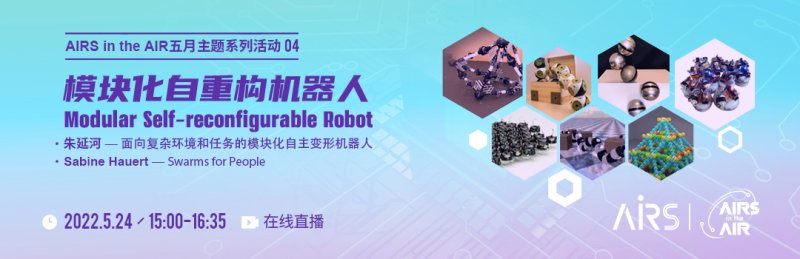
z6首页 in the AIR | Modular Self-reconfigurable Robot (Session 4)

Z6集团|中国官网

Modular self-recon?gurable robots have become a hot research topic in recent years. It is a robot system composed of isomorphic units, which can be changed into appropriate configurations according to different tasks and environments. It is especially suitable for changing environment and complex operation tasks. It has broad application prospects in the fields of rescue, anti-terrorism reconnaissance, space exploration and so on.

In order to promote the theoretical and technological innovation and academic exchanges in the field of modular self-recon?gurable robots at home and abroad, Shenzhen Institute of Artificial Intelligence and Robotics for Society (z6首页) is scheduled to hold "Modular Self-recon?gurable Robots" Series Talk in May 2022. 

Join the event on May 24 through this link: http://hdxu.cn/VLj6g

  • Z6集团|中国官网
    Tin Lun Lam
    Director of Center for Intelligent Robots at z6首页; Assistant Professor at The Chinese University of Hong Kong, Shenzhen
    Executive Chair
  • Z6集团|中国官网
    朱延河
    哈尔滨工业大学教授
    面向复杂环境和工作的模浚浚???榛灾鞅湫位等

    朱延河教授于2004年在哈尔滨工业大学获得机械电子工程专业博士学位,,,,,现任机械人技术与系统国度沉点尝试室副主任,,,,,哈尔滨工业大学教授、博士生导师。。。。。。。国度卓越青年科学基金获得者,,,,,入选国度高档次人才特殊支持打算科技创新领武士才。。。。。。。持久从事机械人有关科学钻研与讲授工作,,,,,重要钻研方向蕴含模浚浚???榛猿凉够等恕⒖纱┐鞅砉趋阑等恕⒓嘶肪撤役机械人等。。。。。。。作为掌管人主持国度天然科学基金沉点项目、国度沉点研发打算、国度核聚变能钻研发展专项、载人航天沉大工程项目等20余项,,,,,钻研成就成功利用于载人航天、核电运维、抢险接济、医疗康复等军民领域。。。。。。。颁发沉要学术论文120余篇,,,,,授权国际/中国发现专利110余项,,,,,获国度级设计金奖1项,,,,,省部级一等奖3项。。。。。。。

    空间索求、煤矿搜救、核电运维等领域的环境复杂、工况极端、工作多样,,,,,传统固定构型机械人难以胜任。。。。。。。模浚浚???榛等丝赡芡üピ??????榧涞淖楹稀⒉鸱质迪止剐偷某列屡渲茫,,,,构成功能各别的机械人,,,,,在职务适应性、职能扩大性和容错与自建复性等方面拥有显著优势。。。。。。。汇报首先对模浚浚???榛等思际踅屑蛞母攀觯,,,,而后介绍了本团队发展的有关钻研,,,,,蕴含模浚浚???樯杓啤⒏兄婊⒊凉棺樽啊⒒疃⒐收险锒嫌肴荽斫ǜ吹龋,,,,这些钻研了局批注,,,,,模浚浚???榛等嗽诟丛踊肪澈凸ぷ髦杏涤辛衫睦迷毒啊。。。。。。

  • Z6集团|中国官网
    Sabine Hauert
    Associate Professor at University of Bristol
    Swarms for people

    Sabine Hauert is Associate Professor (Reader) of Swarm Engineering at University of Bristol. She leads a team of 20 researchers working on making swarms for people, and across scales, from nanorobots for cancer treatment, to larger robots for environmental monitoring, or logistics (https://hauertlab.com/). Before joining the University of Bristol, Sabine engineered swarms of nanoparticles for cancer treatment at MIT, and deployed swarms of flying robots at EPFL. Her recent work has been published in Science Robotics, Science Advances, Advanced Intelligent Systems, Nature Machine Intelligence, and ICRA/IROS and Ra-L. She’s PI or Co-I on more than 20M GBP in grant funding and has served on national and international committees, including the UK Robotics Growth Partnership, the Royal Society Working Group on Machine Learning and Data Community of Interest, and several IEEE boards. She is President and Executive Trustee of non-profits robohub.org and aihub.org, which connect the robotics and AI communities to the public. As an expert in science communication, she is often invited to speak with media and at conferences (over 50 invited talks).

    As tiny robots become individually more sophisticated, and larger robots easier to mass produce, a breakdown of conventional disciplinary silos is enabling swarm engineering to be adopted across scales and applications, from nanomedicine to treat cancer, to cm-sized robots for large-scale environmental monitoring or intralogistics. This convergence of capabilities is facilitating the transfer of lessons learned from one scale to the other. Cm-sized robots that work in the 1000s may operate in a way similar to reaction-diffusion systems at the nanoscale, while sophisticated microrobots may have individual capabilities that allow them to achieve swarm behaviour reminiscent of larger robots with memory, computation, and communication. Although the physics of these systems are fundamentally different, much of their emergent swarm behaviours can be abstracted to their ability to move and react to their local environment. This presents an opportunity to build a unified framework for the engineering of swarms across scales that makes use of machine learning to automatically discover suitable agent designs and behaviours, digital twins to seamlessly move between the digital and physical world, and user studies to explore how to make swarms safe and trustworthy. Such a framework would push the envelope of swarm capabilities, towards making swarms for people.

Time Session Speaker&Topic

15:00-15:45

Keynote Speech

朱延河, 哈尔滨工业大学
Topic: 面向复杂环境和工作的模浚浚???榛灾鞅湫位等

15:50-16:35

Keynote Speech

Sabine Hauert, University of Bristol
Topic: Swarms for people

Video Archive