
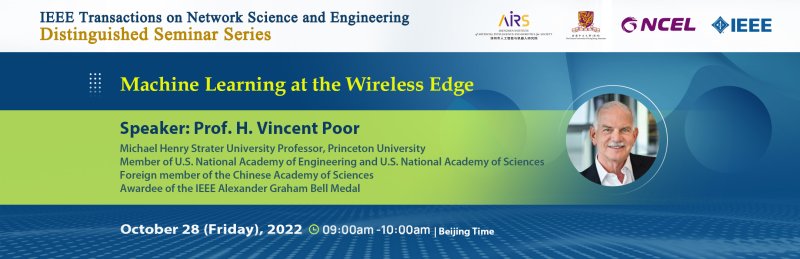

Overview
Date
Oct 28, 2022
09:00 - 10:00
Venue
活动杏注Bilibili

Machine Learning at the Wireless Edge

Z6集团|中国官网

IEEE TNSE Distinguished Seminar Series is co-sponsored by IEEE Transactions on Network Science and Engineering (TNSE) and Shenzhen Institute of Artificial Intelligence and Robotics for Society (z6首页), with joint support from The Chinese University of Hong Kong, Shenzhen, Network Communication and Economics Laboratory (NCEL), and IEEE. This series aims to bring together top international experts and scholars in the field of network science and engineering to share cutting-edge scientific and technological achievements.

Join the seminar on October 28 through 活动行 (http://hdxu.cn/jYZIr) or Bilibili (http://live.bilibili.com/21845454).

  • Z6集团|中国官网
    Jianwei Huang
    Vice President, z6首页; Presidential Chair Professor, CUHK-Shenzhen; Editor-in-Chief, IEEE TNSE; IEEE Fellow; AAIA Fellow
    Executive Chair
  • Z6集团|中国官网
    H. Vincent Poor
    Michael Henry Strater University Professor, Princeton University; Member of U.S. National Academy of Engineering and U.S. National Academy of Sciences; Foreign member of the Chinese Academy of Sciences; Awardee of the IEEE Alexander Graham Bell Medal
    Machine Learning at the Wireless Edge

    H. Vincent Poor 教授现任职于美国普林斯顿大学,, ,,, ,,曾任普林斯顿大学工程与利用科学学院院长。。。。。。 。 。他是美国国度工程院院士、美国国度科学院院士、中国科学院表籍院士,, ,,, ,,英国皇家工程院表籍院士以及其他各类国度和国际科学院院士。。。。。。 。 。他在2017年获得 IEEE 亚历山大·格雷厄姆·贝尔焦芈。。。。。。 。 。他此刻的钻研兴致蕴含信息论、机械进建、网络科学,, ,,, ,,以及这些理论在无线网络、能源系统等有关领域的利用。。。。。。 。 。他在这些领域也做出了巨大贡献,, ,,, ,,最近还刊行了一本书籍 Machine Learning and Wireless Communications (Cambridge University Press, 2022) 。。。。。。 。 。

    Wireless networks can be used as platforms for machine learning, taking advantage of the fact that data is often collected at the edges of the network, and also mitigating the latency and privacy concerns that backhauling data to the cloud can entail. This talk will present an overview of some results on distributed learning at the edges of wireless networks, in which machine learning algorithms interact with the physical limitations of the wireless medium. Two topics will be considered: federated learning, in which end-user devices interact with edge devices such as access points to implement joint learning algorithms; and decentralized learning, in which end-user devices learn by interacting in a peer-to-peer fashion without the benefit of an aggregating edge device. Open topics for future research will also be discussed briefly.

Video Archive