

概述
日期
2024年01月26日
09:00 - 10:00
地址
活动杏注Bilibili

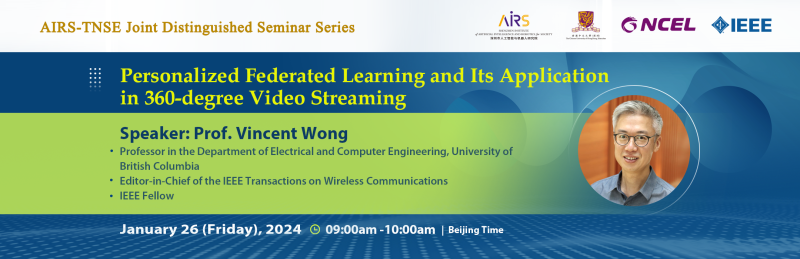
Personalized Federated Learning and Its Application in 360-degree Video Streaming

Z6集团|中国官网

联国进建是一种允很多个边缘设备合作训练一个模型的散布式人为智能框架,, , , ,,,,而个性化联国进建能够解决数据异构性和设备异构性问题。。。。 。。在360度视频流媒体的领域中,, , , ,,,,个性化联国进建算法能够用于训练用户的头部移动预测模型,, , , ,,,,该预测模型是基于内容的视口预测框架中的沉要组成部门。。。。 。。

第十二期z6首页-TNSE结合卓越讲座系列活动,, , , ,,,,我们有幸约请到Vincent Wong教授介绍个性化联国进建及其在360度视频流媒体中的利用,, , , ,,,,并分享他在这个领域内的有关钻研成就与有趣发现。。。。 。。

z6首页-TNSE Joint Distinguished Seminar Series is co-sponsored by IEEE Transactions on Network Science and Engineering (TNSE) and Shenzhen Institute of Artificial Intelligence and Robotics for Society (z6首页), with joint support from The Chinese University of Hong Kong, Shenzhen, Network Communication and Economics Laboratory (NCEL), and IEEE. This series aims to bring together top international experts and scholars in the field of network science and engineering to share cutting-edge scientific and technological achievements.

Join the seminar through Bilibili (http://live.bilibili.com/22587709).

  • Z6集团|中国官网
    Jianwei Huang
    Vice President, z6首页; Presidential Chair Professor, CUHK-Shenzhen; Editor-in-Chief, IEEE TNSE; IEEE Fellow; AAIA Fellow
    Executive Chair
  • Z6集团|中国官网
    Vincent Wong
    Professor in the Department of Electrical and Computer Engineering, Universityof British Columbia; Editor-in-Chief of the lEEE Transactlons on Wireless Communications; IEEE Fellow
    Personalized Federated Learning and Its Application in 360-degree Video Streaming

    Vincent Wong教授是英属哥伦比亚大学电气与推算机工程系的教授。。。。 。。他的钻研领域蕴含通讯网络的和谈设计、优化和资源治理,, , , ,,,,涉及到互联网、无线网络、智能电网、移动边缘推算和物联网蹬爪用。。。。 。。目前,, , , ,,,,Vincent Wong教授担任IEEE Transactions on Wireless Communications的主编。。。。 。。2016年,, , , ,,,,他获评IEEE fellow。。。。 。。

    Federated learning is a distributed artificial intelligence framework, which allows multiple edge devices to train a single model collaboratively. In this talk, we first introduce a personalized federated learning algorithm which can tackle the issues of data heterogeneity and device heterogeneity. Then, we present a content-based viewport prediction framework for 360-degree video streaming, wherein users’ head movement prediction models are trained using a personalized federated learning algorithm. The output of the viewport prediction framework corresponds to which video tiles to be transmitted. Finally, we present an algorithm to determine the bitrate and beamforming matrices in a THz-enabled 360-degree video streaming system with multiple access points.