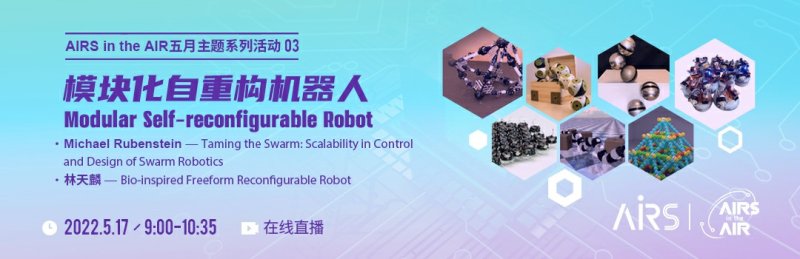
z6首页 in the AIR

概述
日期
2022年05月17日
09:00 - 10:35
地址

活动行

z6首页 in the AIR | Modular Self-reconfigurable Robot (Session 3)

Z6集团|中国官网

Modular self-recon?gurable robots have become a hot research topic in recent years. It is a robot system composed of isomorphic units, which can be changed into appropriate configurations according to different tasks and environments. It is especially suitable for changing environment and complex operation tasks. It has broad application prospects in the fields of rescue, anti-terrorism reconnaissance, space exploration and so on.

In order to promote the theoretical and technological innovation and academic exchanges in the field of modular self-recon?gurable robots at home and abroad, Shenzhen Institute of Artificial Intelligence and Robotics for Society (z6首页) is scheduled to hold "Modular Self-recon?gurable Robots" Series Talk in May 2022. 

Join the event on May 17 through this link: http://hdxu.cn/F28BI

  • Z6集团|中国官网
    Tin Lun Lam
    Director of Center for Intelligent Robots at z6首页; Assistant Professor at The Chinese University of Hong Kong, Shenzhen
    Executive Chair
  • Z6集团|中国官网
    Michael Rubenstein
    Assistant Professor at Northwestern University
    Taming the Swarm: Scalability in Control and Design of Swarm Robotics

    Michael Rubenstein is currently an assistant professor at Northwestern's McCormick School of Engineering.  There he is working on Kilobot, a robot designed for testing swarm algorithms in a group of over a thousand robots.  He received his Ph.D. from The University of Southern California's School of Computer Science under the supervision of Wei-Min Shen.  His thesis, titled: "Self-Assembly and Self-Healing for Robotic Collectives", details a control algorithm for a simple, simulated multi-robot system which guarantees that it can self-assemble and self-heal any desired connected shape.  Most of his research is centered around the design and control of multi-robot systems.  Additional information can be found at his webpage: http://users.eecs.northwestern.edu/~mrubenst/

    Advances in technology have begun to allow for the production of large groups, or swarms, of robots; however, there exists a large gap between their current capabilities and those of swarms found in nature or envisioned for future robot swarms.  These deficiencies are the result of two factors, difficulties in algorithmic control of these swarms, and limitations in hardware capabilities of the individuals.

    Creating a hardware system for large robotic swarms is an open challenge; cost and manufacturability pressure hardware designs to be simple with minimal capabilities, while algorithm design favors more capable hardware. The robot design must balance these factors to create a simple robot that is, at the same time, capable of performing the desired behaviors.  In this talk, I will discuss the many challenges associated with creating a robot swarm at this scale and the implications this has for creating even larger, more capable swarms in the future.

  • Z6集团|中国官网
    Tin Lun Lam
    Director of Center for Intelligent Robots at z6首页; Assistant Professor at The Chinese University of Hong Kong, Shenzhen
    Bio-inspired Freeform Reconfigurable Robot

    Tin Lun Lam, Senior Member of IEEE, serves as Assistant Professor of the Chinese University of Hong Kong, Shenzhen, Executive Deputy Director of the National-local Joint Engineering Laboratory of Robotics and Intelligent Manufacturing, and Director of the Center for Intelligent Robots of Shenzhen Institute of Artificial Intelligence and Robotics for Society. He received his B.Eng. Degree with First Class Honors and Ph.D. Degree in Robotics and Automation from the Chinese University of Hong Kong in 2006 and 2010, respectively. The research focus includes multi-robot systems, field robotics, and human-robot collaboration. He has been granted over 60 patents, published 2 monographs, and over 60 international journal and conference papers. Most of them were published in top-tier international journals and conference proceedings in robotics and automation, such as TRO, JFR, T-MECH, RA-L, ICRA, and IROS. Based on his research, he received an IEEE/ASME T-MECH Best Paper Award in 2011 and IROS Best Paper Award on Robot Mechanisms and Design in 2020. His research outcomes are also reported in many popular media, including Reuters, Discovery Channel, IEEE Spectrum, and NHK.

    A general-purpose robotic system that can change its configuration to achieve different capabilities is of great value to application scenarios with substantial uncertainty, such as exploration, search and rescue in hazard fields. Inspired by the great flexibility and adaptability of biological swarms such as ants and slime molds in facing dynamic environments, the modular self-reconfigurable robot is one of the promising directions for realizing general-purpose robots. The modular self-reconfigurable robots can form different shapes to achieve different capabilities by the autonomous connection and motion among simple modular robots. Due to the mechanical constraints, modular robots only provide several connecting points for other robots, which is different from the natural biological swarms that can connect anywhere with their fellows. The restricted location of connection highly limited the flexibility and increased the connection complexity of the modular self-reconfigurable robots. Is it possible to get one step closer to the capability of the biological swarms by enabling modular self-reconfigurable robots to have more freedom in forming their shape? This talk will introduce some of our recent attempts at tackling this challenge.

Time Session Speaker&Topic

09:00-09:45

Keynote Speech

Michael Rubenstein, Northwestern University
Topic: Taming the Swarm: Scalability in Control and Design of Swarm Robotics

09:50-10:35

Keynote Speech

Tin Lun Lam, The University of Hong Kong, Shenzhen
Topic: Bio-inspired Freeform Reconfigurable Robot

Video Archive