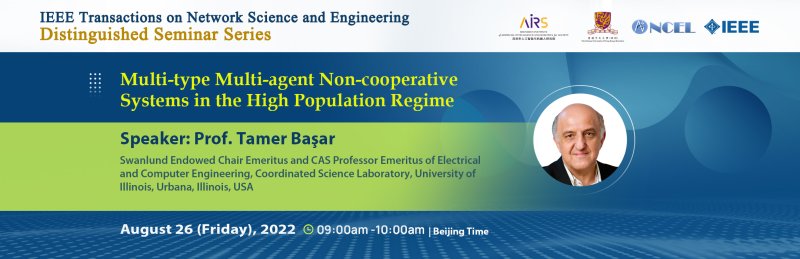
Perhaps the most challenging aspect of research on multi-agent dynamical systems, formulated as non-cooperative stochastic games with asymmetric dynamic information, is the presence of strategic interactions among agents, with each one developing beliefs on others in the absence of shared information. This belief generation process involves what is known as second-guessing phenomenon, which generally entails infinite recursions, thus compounding the difficulty of obtaining an equilibrium. This difficulty is somewhat alleviated when there is a high population of agents, in which case strategic interactions at the level of each agent become much less pronounced. With some structural specifications, this leads to what is known as mean field games (MFGs), which have been the subject of intense research activity during the last fifteen years or so. Following a general overview of fundamentals of MFGs approach to decision making in multi-agent dynamical systems, the talk will introduce a framework where the agents are partitioned into finitely-many populations with an underlying graph topology, with each population having a high number of indistinguishable agents. Results on existence, uniqueness, and characterization of equilibria will be presented, along with learning such equilibria in model-free settings. The talk will conclude with a discussion of future research directions.